Forestry Mulching in Michigan: Turning Wildfire Fuel Into a Wildfire-Ready Property
Look up. If you’re anywhere in Michigan this month, the sky has probably looked less like Pure Michigan and more like a campfire that got out of hand. That’s not fog. That’s Canada.
As of July 16, there were 857 active wildfires burning across Canada, with 113 of them officially classified as out of control. The smoke drifted south, and Metro Detroit ended up with the worst air quality of any major city in the world during the event, according to IQAir. Windows closed. Air conditioners cranked. Outdoor plans canceled.
Here’s the part nobody’s talking about at the block party: the same basic fuel that’s feeding those fires up north is sitting in a lot of Michigan backyards, tree lines, and vacant lots right now. Forestry mulching is how you get rid of it before it becomes your problem instead of Canada’s.
What’s Actually Happening in the Sky Over Michigan
This isn’t a one-off haze day. Michigan has been under a statewide air quality alert, with PM2.5 levels hitting “Very Unhealthy” in the Lower Peninsula and “Hazardous” in the Upper Peninsula. That’s smoke traveling hundreds of miles and still landing hard.
The state’s advice has been simple: stay inside, keep windows shut, run your AC with a good filter. Solid advice for this week. Less helpful for the actual source of the problem, which is fuel. Wildfires need something to burn, and dense, dry, untouched vegetation is exactly that.
The Fuel Problem Didn’t Stay in Canada
Michigan isn’t Canada’s boreal forest, sure. But “it can’t happen here” is a weaker argument than it used to be, and the fuel math doesn’t care which side of the border it’s on.
What Counts as Fuel on Your Own Property
Fire scientists talk about “ladder fuels,” which is a fancy way of describing exactly what it sounds like: low brush and dead grass at ground level that lets fire climb up into shrubs, then into low tree branches, then into the canopy. One dry summer and an overgrown lot has built its own staircase.
If your property has thick underbrush, dead fall, scrubby regrowth, or a tree line nobody’s touched since the last owner sold it, you’ve got ladder fuel. It doesn’t need a lightning strike from the news. A grill spark, a dragging trailer chain, or a tossed cigarette will do just fine.
Why “It Can’t Happen Here” Is a Riskier Bet Than It Used to Be
Michigan summers are getting hotter and drier in stretches, and the smoke events keep showing up earlier in the season. You don’t need Michigan to become California for this to matter. You just need one dry August and one careless spark on a property that’s never been cleared.
What Forestry Mulching in Michigan Actually Does
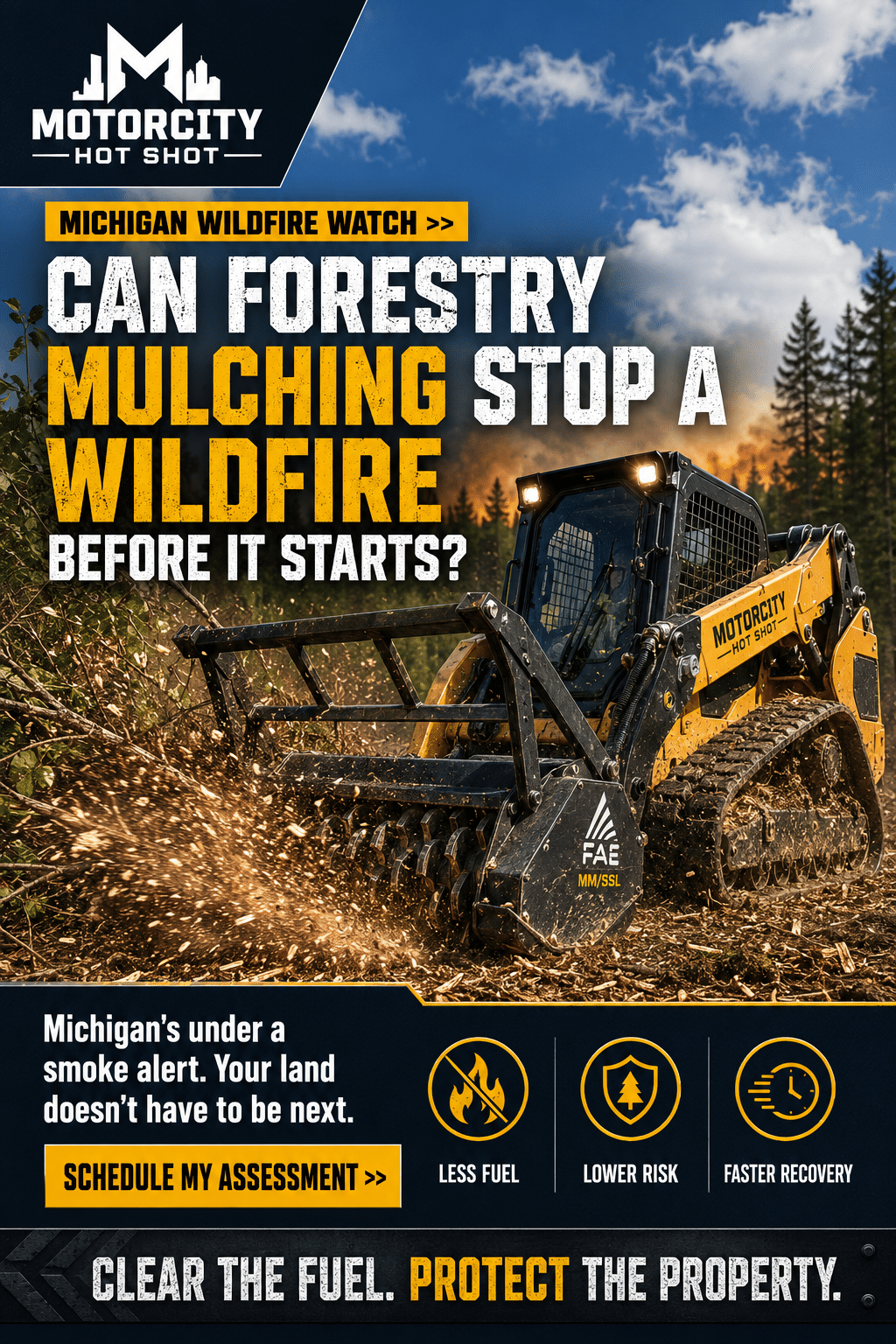
This is where forestry mulching earns its keep. Instead of burning brush (which, ironically, adds more smoke to an already smoky summer) or hauling it off-site truckload by truckload, mulching grinds standing brush, small trees, and debris right where it stands and turns it into a layer of mulch on the ground.
From Overgrown to Wildfire-Ready
That mulch layer does double duty. It removes the ladder fuel that lets fire climb, and it holds moisture at ground level, which makes what’s left harder to ignite in the first place. The result is what we call a Wildfire-Ready Zone: a property that isn’t offering up free fuel to the next spark that comes along.
Why Mulching Beats Burning or Hauling
Burning brush piles adds smoke to a season that already has plenty. Hauling debris off-site means more trucks, more time, and more cost. Mulching does it in one pass, on-site, with equipment built for exactly this job. Faster, cleaner, and it leaves your land in better shape than it started.
If your property has more brush than backyard, this is the moment to stop putting it off. Schedule a Wildfire-Ready Property Assessment and we’ll walk your land and tell you exactly what’s fuel and what’s fine.
The Cost of Waiting
Here’s the catch with clearing land once and calling it done: nature doesn’t respect your to-do list. Regrowth, dropped needles, and new debris can rebuild a fuel problem within 1 to 2 seasons if nothing’s maintained. A Wildfire-Ready Zone isn’t a one-time haircut. It’s upkeep, the same way you wouldn’t mow your lawn once in May and call it good for the summer.
The good news: once the heavy lifting is done, staying ahead of it is a lot cheaper and faster than the first clear.
The Michigan Wildfire Questions Everyone’s Suddenly Asking
Is Michigan actually at risk for wildfires, or is this just smoke passing through from Canada?
Both. This month’s haze is Canadian, but Michigan has its own history. The Duck Lake Fire burned 21,135 acres in the Upper Peninsula in 2012, and the Great Michigan Fire of 1871 torched an estimated 2.5 million acres, still the third largest wildfire in U.S. history. The DNR responds to 10,000 to 12,000 wildfires in Michigan every year.
Why is smoke from Canadian wildfires hitting Michigan so hard?
Wind carries fine particulate (PM2.5) hundreds of miles south. During this event, Metro Detroit posted the worst air quality of any major city in the world, according to IQAir, and the state issued a statewide air quality alert.
When is wildfire season in Michigan?
Michigan wildfires happen in spring, between April and June, before dead grass and fallen leaves green back up. That said, hot, dry stretches like this summer push fire danger into “high to very high” territory outside that window too.
What actually causes most wildfires in Michigan?
People, not lightning. The DNR reports that roughly 9 out of 10 Michigan wildfires are human caused. Debris burning, unattended campfires, dragging trailer chains, and power equipment or off-road vehicles used in dry conditions are the usual suspects.
Does Michigan have anything like “defensible space” for homeowners?
Yes, it’s called Firewise, and Michigan DNR and MSU Extension put real numbers behind it: a noncombustible 3-foot ring immediately around your home, pruned lower branches out to 30 feet, and thinned trees between 30 and 100 feet out. That’s the official version of what we’re calling a Wildfire-Ready Zone.
Can I just burn the brush myself instead of paying for mulching?
You can, if you have a permit. Open burning of yard waste is restricted across much of Michigan, and you’re required to check daily with the DNR or your local authority before lighting anything. Forestry Mulching skips the permit, skips the smoke, and gets it done in one pass.
Does forestry mulching actually make a measurable difference?
Yes. It removes the ladder fuel that lets fire climb from ground brush into tree canopy, and the mulch layer left behind holds moisture, making what’s left harder to ignite. The tradeoff: regrowth can rebuild that fuel load within 1 to 2 seasons, so it’s maintenance, not a one-time fix.
Don’t Wait for the Next Smoke Alert to Make the Call
Michigan will get another clear week. The fires up north will get contained eventually, the air quality alerts will lift, and it’ll be easy to forget any of this happened.
That’s exactly the window when an overgrown property stays overgrown. The fuel doesn’t clear itself, and the next dry stretch won’t wait for a convenient time to show up.
Get ahead of it while it’s still top of mind, not after the next alert hits your phone.