Dirt Work Done Right: When You Need Excavation, Grading, or Both
Not all dirt work is created equal.
Sometimes you need to remove soil, shape the land, dig out an area, open up access, or prepare a site for something new. Other times, you need to smooth, level, slope, or redirect the surface so water moves where it should instead of creating a backyard swamp that makes ducks look at your property and say, “Nice place.”
That is where the difference between excavation and grading matters.
The two services are closely related, and they often work together. But they are not the same thing. Understanding the difference can help you plan your project better, avoid drainage problems, and make sure your land is prepared the right way from the start.
At MotorCity Hot Shot, we help property owners across Michigan, northern Ohio, and northern Indiana tackle serious land improvement projects, including excavation, grading, land clearing, forestry mulching, habitat management, and more.
So, let’s dig in.
Yes, that was intentional.
What Is Excavation?
Excavation is the process of digging, removing, cutting, or moving soil, rock, clay, debris, or other materials from a specific area.
In simple terms, excavation is about creating space, removing material, or reshaping the ground below or around the surface.
Excavation may be needed when you are preparing land for a driveway, pond, building pad, drainage improvement, utility access, culvert, trail, access road, or other site improvement project.
Common Excavation Projects Include:
- Digging out low spots or problem areas
- Removing unwanted soil, clay, or material
- Creating or expanding access paths
- Preparing areas for driveways or parking pads
- Cutting into slopes or uneven terrain
- Shaping recreational ponds or water features
- Opening up drainage areas
- Removing stumps, roots, rocks, or debris from a work zone
- Preparing land after clearing or forestry mulching
Excavation is typically the heavier, deeper, more aggressive part of dirt work. It’s the “we need to move material out of the way” phase.
Think of excavation as the part where the land gets opened up, cut down, dug out, or reshaped so the next phase of the project can happen correctly.
What Is Grading?
Grading is the process of shaping and sloping the surface of the land so it drains, settles, and functions properly.
Where excavation is often about removing or digging material, grading is about creating the right finished shape.
Proper grading helps control how water moves across a property. That matters because water is lazy, sneaky, and extremely committed to finding the lowest point possible. If your land is not graded correctly, water can pool, wash out soil, flood low areas, damage driveways, collect near structures, or turn useful land into a muddy obstacle course.
Professional grading helps make water flow more predictable by shaping the land according to elevations, slopes, drainage patterns, soil conditions, and the intended use of the property. EPA guidance notes that grading plans should account for soil types, slopes, drainage patterns, stormwater controls, and proposed land use, while PNNL recommends site grading to help control stormwater runoff and prevent soil saturation around foundations.
Common Grading Projects Include:
- Leveling uneven ground
- Creating positive drainage
- Sloping land away from structures or work areas
- Smoothing out ruts, bumps, and rough areas
- Preparing a driveway or access road base
- Reworking areas with standing water
- Improving surface water flow
- Shaping land after excavation or clearing
- Preparing a site for gravel, seed, stone, or additional improvements
Grading is the “make it functional and finish the shape” part of the process.
It is not just about making dirt look pretty. Although, yes, a clean final grade does look deeply satisfying in a very “equipment operator masterpiece” kind of way.
Excavation vs Grading: The Simple Difference
The simplest way to understand excavation vs grading is this:
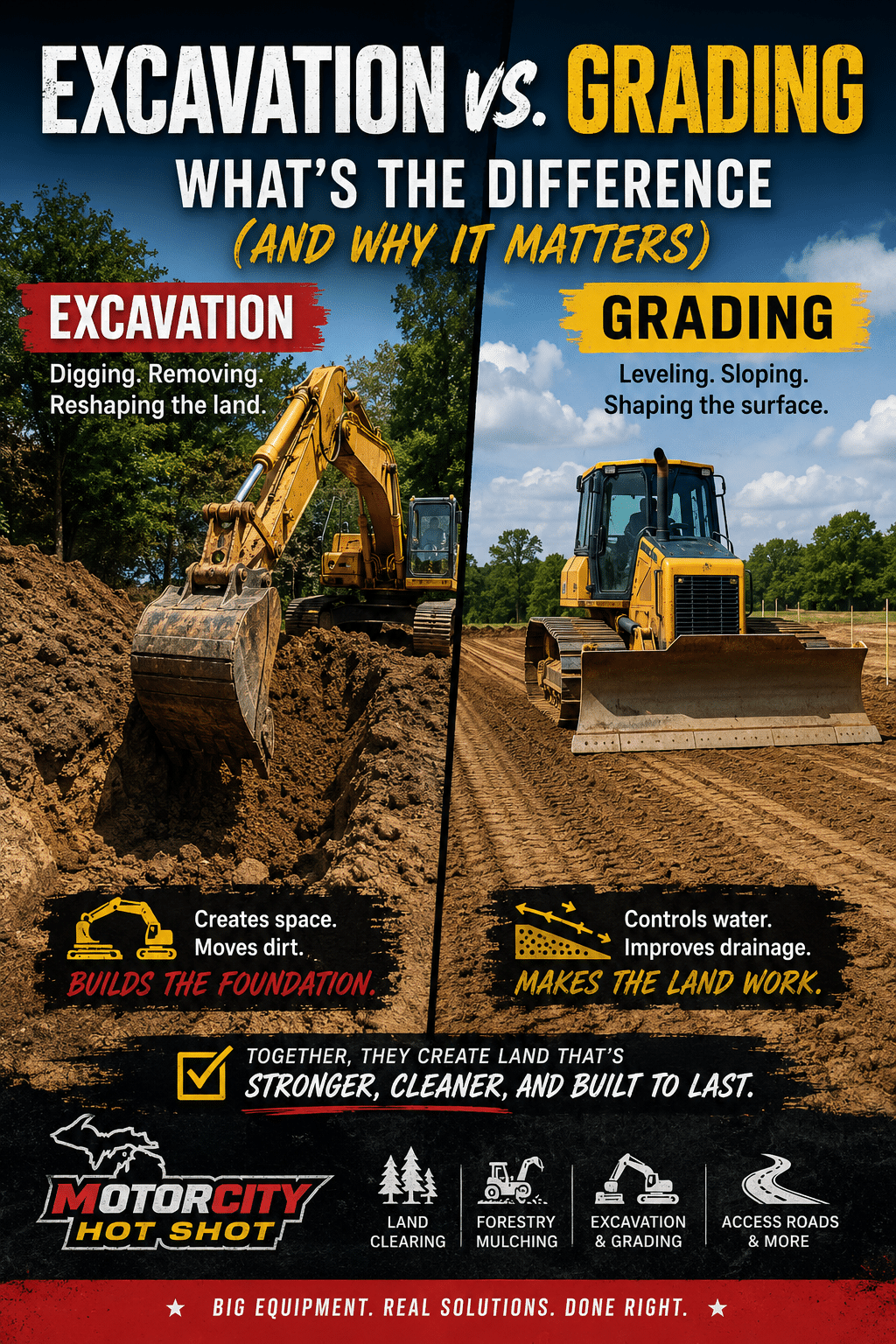
Excavation removes, digs, cuts, or moves material. Grading shapes, levels, and slopes the surface.
Both involve moving dirt. Both require the right equipment. Both can dramatically improve how a property functions.
But they solve different problems.
Excavation Is Usually Needed When:
You need to dig down, remove material, create space, reshape a rough area, open access, or prepare a site for a larger improvement.
Grading Is Usually Needed When:
You need to smooth, level, slope, or redirect the surface so water drains properly and the land can be used safely and effectively.
Many Projects Need Both
For example, if you are preparing a new gravel driveway through a wooded or overgrown area, the project may require:
- Clearing brush, trees, or overgrowth
- Excavating unsuitable material or cutting into uneven ground
- Grading the surface to create the proper slope and base
- Adding gravel or final surface material
Excavation gets the land ready. Grading makes the land work.
Why Proper Grading Matters More Than Most People Realize
Improper grading is one of the biggest contributors to drainage problems on a property.
When land is too flat, sloped the wrong way, uneven, compacted improperly, or shaped without considering where water naturally wants to go, problems can show up fast.
And water problems are not shy.
They announce themselves with puddles, ruts, soggy soil, erosion, washed-out gravel, muddy access routes, flooded low spots, and that unmistakable feeling of “well, that got expensive.”
Poor Grading Can Cause:
- Standing water
- Soil erosion
- Washed-out driveways or access paths
- Soft or unstable ground
- Drainage failure
- Water collecting near buildings, barns, garages, or work areas
- Damage to newly improved land
- More maintenance over time
PNNL specifically recommends grading sites to control stormwater runoff and prevent soil saturation around foundations, which reinforces why proper slope and drainage planning matter before water problems become expensive problems.
In other words, grading is not just the final “smooth it out” step.
It is the part that helps determine whether the project holds up.
Why Excavation Matters Before Grading
Grading can only do so much if the land underneath is not properly prepared.
If the work area has buried debris, unsuitable soil, heavy roots, stumps, rocks, old material, deep ruts, unstable ground, or an incorrect base, simply smoothing the surface may not solve the real problem.
That is where excavation comes in.
Excavation allows the crew to remove, cut, dig, or reshape the problem area before the final grade is established.
Excavation May Be Required Before Grading If:
- The site has major high and low spots
- Soil needs to be removed or relocated
- Clay or unsuitable material is causing drainage issues
- The project area needs to be opened up or widened
- There are roots, stumps, rocks, or debris in the way
- Water is collecting because the land shape is fundamentally wrong
- A driveway, trail, pond, or pad needs a proper base
Skipping excavation when it is needed is like putting new carpet over a floor that is shaped like a potato chip. Technically, you did something. But no one is going to brag about the result.
When Do You Need Excavation?
You likely need excavation when your project requires more than surface-level smoothing.
If the land needs to be cut, dug out, opened up, reshaped, or cleared of unsuitable material, excavation is probably part of the plan.
You May Need Excavation For:
Driveway or Access Road Prep
If you are building or improving a driveway, trail, or access path, excavation may be needed to remove soft material, lower high spots, widen the path, or create a proper base.
Drainage Corrections
If water is collecting because the land has the wrong shape, excavation may be needed to create swales, open drainage paths, remove blockages, or reshape low areas.
Recreational Pond Work
Pond projects often require significant excavation to remove soil, create depth, shape edges, and prepare the surrounding land.
Land Clearing Follow-Up
After forestry mulching or land clearing, excavation may be needed to remove larger debris, improve access, or prepare specific areas for future use.
Site Prep
If you are preparing land for a barn, outbuilding, parking area, gravel pad, or other improvement, excavation may be needed before grading can create the finished surface.
When Do You Need Grading?
You likely need grading when the surface of your land needs to be leveled, smoothed, sloped, or shaped for better drainage and usability.
Grading is especially important after excavation, land clearing, forestry mulching, driveway work, pond work, or any project that changes the surface of the property.
You May Need Grading For:
Standing Water or Poor Drainage
If water pools in certain areas after rain, the land may need to be graded to redirect runoff.
Rough or Uneven Ground
Ruts, bumps, dips, and uneven terrain can make land difficult to use, maintain, mow, or access.
Driveway or Gravel Area Prep
A proper grade helps create a better base for gravel and reduces the chance of water washing it away.
Yard or Field Improvements
If you are reclaiming overgrown land or improving usable acreage, grading can help make the surface more practical.
Post-Excavation Finish Work
After digging or moving material, grading helps create the finished shape so the land drains and functions properly.
The Big Mistake: Treating Excavation and Grading Like the Same Thing
One of the most common mistakes property owners make is assuming that all dirt work is the same.
It is not.
A project that needs excavation may fail if it only gets light grading. A project that only needs grading may become unnecessarily expensive if it is treated like a full excavation job.
The right approach depends on the site conditions, the problem you are trying to solve, and what you want the land to do when the work is finished.
Example 1: The Muddy Driveway
If your driveway keeps washing out, the issue may not be solved by simply adding more gravel.
The area may need excavation to remove unsuitable material, followed by grading to create the right slope and water flow.
Example 2: The Soggy Field
If one section of your property stays wet long after the rest dries out, grading may help redirect surface water.
But if the problem area is too low or compacted, excavation may be needed first.
Example 3: The New Access Trail
If you want to open access through wooded or overgrown land, the project may start with clearing or forestry mulching, then require excavation to remove obstacles or reshape rough areas, and finally grading to create a usable path.
That is why the best dirt work starts with a good look at the land.
The dirt usually tells the truth. It just does it quietly and with more mud.
Why Professional Excavation and Grading Are Worth It
Excavation and grading are not just about moving dirt from one place to another.
They are about understanding how the land behaves, how water moves, what equipment is needed, and how to complete the work in a way that supports the long-term goal of the project.
Professional grading improves water flow predictability because the slope, elevation, drainage direction, soil conditions, and intended use are all considered before the surface is finished. EPA guidance on land grading emphasizes that grading plans should identify land elevations, slopes, drainage patterns, construction schedules, and erosion and sediment controls.
Professional Dirt Work Helps You:
- Avoid repeated drainage problems
- Reduce erosion and washouts
- Improve access and usability
- Prepare land for future improvements
- Prevent wasted money on temporary fixes
- Make better use of your property
- Create a cleaner, more functional finished result
There is a big difference between “moving dirt” and moving dirt with a plan.
One creates progress.
The other creates a mess with tire tracks.
How MotorCity Hot Shot Approaches Excavation and Grading Projects
At MotorCity Hot Shot, we look at excavation and grading as part of the bigger picture.
Before recommending the best approach, we consider what the land looks like now, what problem needs to be solved, how water is moving, what obstacles are in the way, and what the property owner wants the area to become.
Depending on the project, we may recommend excavation, grading, forestry mulching, land clearing, or a combination of services.
Our Goal Is Simple:
Make your land more usable, more manageable, and better prepared for whatever comes next.
That might mean opening up an access path, improving drainage, preparing a gravel area, cleaning up overgrown land, reshaping rough terrain, or turning a problem area into a functional part of your property.
No fluff. No overcomplication. Just the right equipment, the right plan, and the kind of dirt work that makes your property feel like it finally got its act together.
Excavation vs Grading: Which Service Do You Need?
Here is the easiest way to think about it:
Choose Excavation If You Need To:
- Dig
- Cut
- Remove material
- Open up space
- Create depth
- Reshape rough terrain
- Prepare for a pond, driveway, pad, trail, or drainage improvement
Choose Grading If You Need To:
- Level
- Smooth
- Slope
- Redirect water
- Improve drainage
- Finish the surface
- Prepare land for better use or future improvements
Choose Both If You Need A Complete Land Improvement Solution
Many of the best results come from combining excavation and grading.
Excavation solves the deeper problem. Grading finishes the surface so the land works the way it should.
Together, they help prevent the classic landowner nightmare: spending money on a project that looks good for about three rainstorms before nature politely destroys it.
Ready to Improve Your Land the Right Way?
Whether you need excavation, grading, or a combination of services, MotorCity Hot Shot can help you figure out the right approach for your property.
If your land has drainage problems, rough terrain, muddy access areas, standing water, washouts, or a project that needs serious site prep, we can help turn that problem area into usable ground.
Request an Excavation & Grading Quote
Let’s take a look at your property, talk through what you want to accomplish, and recommend the right dirt work solution.
Request an Excavation & Grading Quote today and let’s get your land moving in the right direction.
Frequently Asked Questions About Excavation and Grading
1. What is the difference between excavation and grading?
Excavation is the process of digging, cutting, removing, or moving soil, rock, clay, stumps, roots, and other material from a specific area. Grading is the process of shaping, leveling, and sloping the surface of the land so it drains properly and functions the way it should.
The easiest way to remember it is this: excavation creates space, while grading creates shape. Excavation usually handles the heavier digging and removal work. Grading fine-tunes the surface so water flows where it should instead of turning your property into a mud-flavored slip-and-slide.
2. Do I need excavation or grading for drainage problems?
It depends on what is causing the drainage issue. If water is pooling because the surface is uneven or sloped the wrong way, grading may be enough to redirect water. If the problem is deeper, such as compacted soil, buried debris, a low area that needs to be cut out, or a major terrain issue, excavation may be needed before grading can solve the problem.
Professional grading plans often account for slopes, drainage patterns, soil types, stormwater controls, and intended land use, which is why drainage work should be planned carefully instead of handled with a “let’s just push some dirt around and hope for the best” approach.
3. Why is proper grading important?
Proper grading helps control how water moves across your property. When land is graded correctly, water becomes more predictable. It can be directed away from structures, driveways, access paths, low areas, and places where standing water can cause problems.
Poor grading can lead to pooling water, erosion, washouts, muddy access areas, soft ground, and water collecting where it absolutely was not invited. PNNL’s Building America Solution Center recommends site grading, swales, and drains to help control stormwater runoff and prevent soil saturation around foundations.
4. Can grading fix standing water in my yard or field?
In many cases, yes. Grading can often help fix standing water by reshaping the land so water flows away from low spots and toward better drainage areas. However, grading is not always the entire solution.
If the standing water is caused by heavy clay, compacted soil, blocked drainage, buried debris, or a naturally low section of land, the project may also require excavation, swales, drainage improvements, or additional site work. Basically, if the water has set up a long-term lease on your property, it may take more than a light surface adjustment to evict it.
5. Does excavation always come before grading?
Usually, yes. On many projects, excavation happens first because material may need to be removed, cut down, relocated, or reshaped before the final grade can be established.
Once excavation creates the right rough shape or clears the problem area, grading finishes the surface by smoothing, leveling, and sloping it properly. Think of excavation as the heavy lifting and grading as the “make it work correctly and look like professionals were here” phase.
6. What types of projects require excavation?
Excavation is commonly needed for projects that involve digging, removing material, reshaping land, or preparing an area for future use.
Common excavation projects include driveway prep, access road creation, drainage corrections, recreational pond work, culvert areas, trail clearing, site prep, stump and root removal, and reshaping rough or unusable terrain.
If the project requires going below the surface, removing material, or changing the structure of the land, excavation is probably part of the conversation.
7. What types of projects require grading?
Grading is commonly needed when land must be leveled, smoothed, sloped, or shaped to improve drainage and usability.
Common grading projects include driveway base prep, yard leveling, access path improvements, drainage corrections, post-excavation finishing, land clearing follow-up, gravel pad prep, field smoothing, and correcting ruts or uneven ground.
Grading is especially important after excavation or clearing because disturbed land needs to be shaped properly before it can perform well over time.
8. Can excavation and grading help prevent erosion?
Yes. Proper excavation and grading can help reduce erosion by improving how water moves across the property. When water runs too quickly, flows in the wrong direction, or collects in weak areas, it can wash away soil, damage driveways, create ruts, and make a mess of otherwise usable land.
Michigan EGLE guidance notes that grading plans can help establish drainage areas, direct drainage patterns, and decrease runoff velocities. In plain English: good grading helps water behave itself. Mostly. Water still has a personality.
9. How do I know if my property has a grading problem?
Common signs of a grading problem include standing water, muddy low spots, washed-out gravel, erosion, water flowing toward structures, soft ground, ruts, uneven surfaces, and areas that stay wet long after everything else dries out.
If your property has one problem area that seems to get worse after every heavy rain, grading may be part of the solution. If the issue keeps coming back after temporary fixes, it may be time to have the land professionally assessed.
10. Is grading just leveling the ground?
No. Grading can include leveling, but good grading is not simply making land flat. In fact, making land too flat can create drainage problems because water needs a predictable path to move.
Proper grading usually involves shaping the land with the right slope, elevation, and contour so water flows away from problem areas. PNNL notes that final grades around homes should slope away from foundations to help direct stormwater runoff away from the structure.
11. Can I do grading myself?
Small touch-ups may be manageable for some property owners, but larger grading projects are usually best handled by professionals with the right equipment and experience.
The challenge is that grading mistakes are not always obvious immediately. A surface can look fine on a sunny day and then reveal every bad decision during the next heavy rain. Professional grading considers slope, drainage direction, soil conditions, runoff patterns, and how the property will be used.
That is a lot more than “looks level from the porch.”
12. How much does excavation and grading cost?
The cost of excavation and grading depends on the size of the project, site conditions, equipment needed, access, soil type, terrain, amount of material to move, drainage issues, and whether additional services like land clearing or forestry mulching are needed.
A small grading project may be relatively straightforward. A larger excavation and grading project involving drainage corrections, rough terrain, stumps, clay, or access limitations can require more time and planning. The best way to get an accurate number is to request a quote based on the actual property and scope of work.
13. What should I ask before hiring an excavation and grading contractor?
Before hiring a contractor, ask what problem they are solving, whether excavation, grading, or both are needed, how they will address drainage, what equipment they plan to use, how they price the work, and what the finished result should accomplish.
You want someone who is not just moving dirt. You want someone who understands how the land should function when the job is done.
14. When is the best time of year for excavation and grading?
Excavation and grading can often be done throughout much of the year, depending on weather, ground conditions, access, and the type of project. Spring and summer are common because property owners are preparing land for projects, driveways, ponds, trails, or improvements. Fall can also be a smart time to address drainage or access issues before winter weather shows up with its usual Michigan charm.
The right timing depends on what you need done and whether the property is accessible for equipment.
15. Do I need land clearing before excavation or grading?
Sometimes, yes. If the project area is overgrown, wooded, full of brush, covered with stumps, or blocked by debris, land clearing or forestry mulching may be needed before excavation or grading can happen properly.
Clearing opens up the work area. Excavation reshapes or removes material. Grading finishes the surface. When done in the right order, the whole project works better and looks cleaner.
Not sure whether your property needs excavation, grading, or both?
MotorCity Hot Shot can help you figure out the right dirt work plan without turning the answer into a 47-page engineering dissertation.
Request an Excavation & Grading Quote today and let’s get your land moving in the right direction.