Why Smarter Clearing Creates Better Wildlife Habitat in Michigan
When a lot of people hear the word “land clearing,” they picture bulldozers, bare dirt, and a property that suddenly looks like it lost an argument with common sense.
That is not what good habitat management looks like.
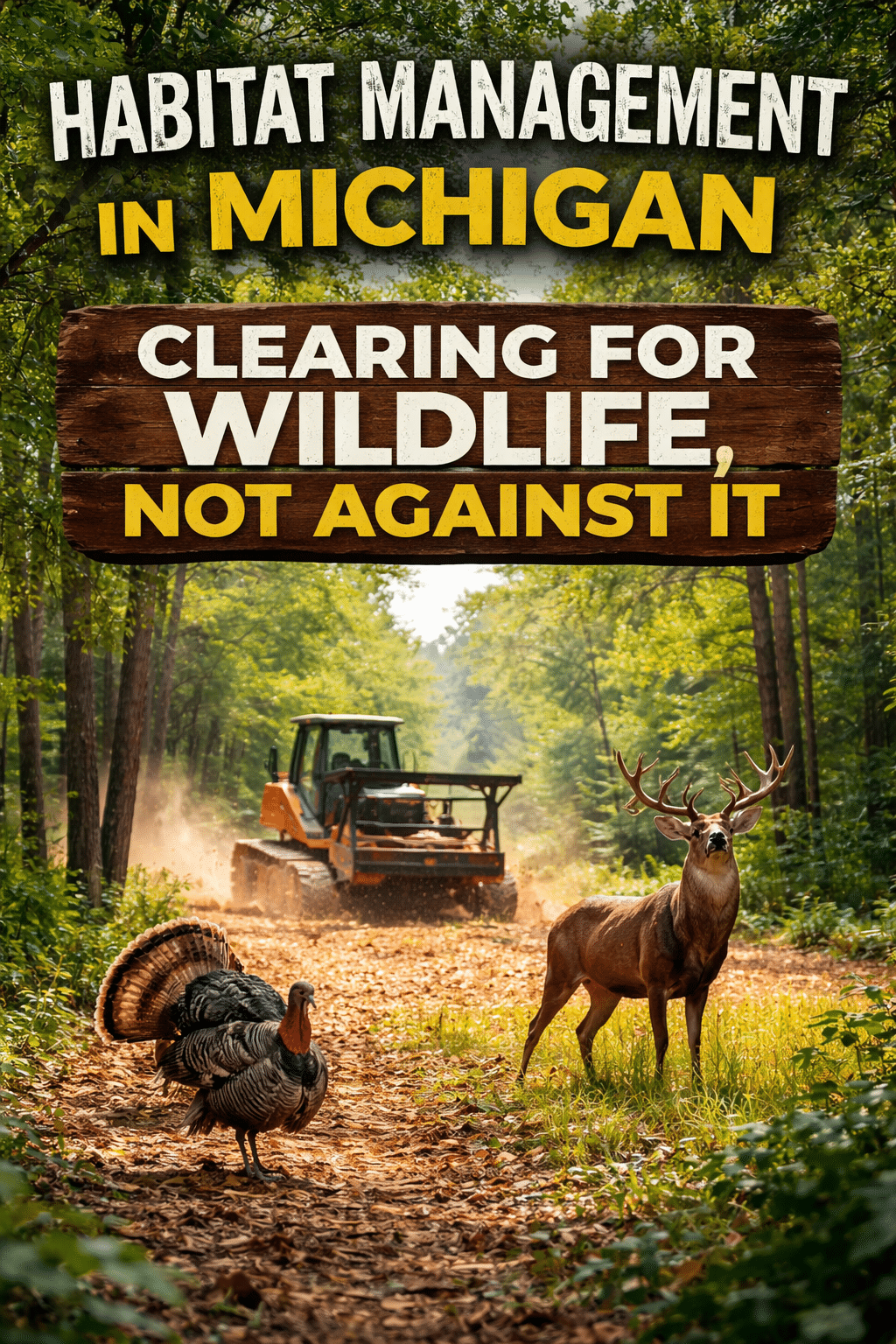
Done right, habitat management in Michigan is about improving the balance of your land so wildlife can move better, feed better, bed better, and thrive better. It is not about clearing everything. It is about clearing strategically. The goal is to create the right mix of woods, cover, travel corridors, sunlight, browse, and edge habitat so deer, turkey, and other wildlife actually want to use the property. Michigan State University Extension notes that habitat planning should start with the needs of the wildlife you want to support, then evaluate the food, cover, water, and space already on the land.
That is where MotorCity Hot Shot comes in. We help landowners clear with purpose, not chaos, so the land works harder for wildlife instead of against it.
What Habitat Management Actually Means
Habitat management is the process of improving land so it provides what wildlife need most: food, cover, water, and space. Those needs sound simple, but the way they come together on a property makes all the difference. Wildlife professionals consistently point to those four elements as the foundation of quality habitat, and they stress that different species use the same property in very different ways.
That is why random clearing usually falls flat.
If a property is all mature woods with very little understory, it may look nice to humans, but it may not offer much browse or ground-level cover. If it is all thick mess with no travel lanes, no openings, and no sunlight reaching the ground, it can choke out diversity and make the land less useful overall. Strategic habitat work creates a better blend.
In other words, the best wildlife properties are not the cleanest. They are the most intentional.
Why Strategic Clearing Helps Wildlife
Edge habitat creates more wildlife activity
One of the most valuable features on a property is edge habitat — the transition zone where two habitat types meet, like woods and openings, brush and trails, or timber and native growth. Wildlife management guidance notes that deer, turkey, and grouse often prefer these edge areas because they typically offer more browse and vegetation.
That matters because edge habitat tends to create exactly what wildlife want:
more food within reach, more cover nearby, and better movement between bedding, feeding, and travel areas.
So no, the answer is not to flatten the property. The answer is often to create more usable edges in the right places.
Managed openings improve forage diversity
When sunlight hits the ground, good things start happening.
Strategic clearing can open the canopy just enough to stimulate native grasses, forbs, shrubs, and young woody growth. That kind of early successional habitat is especially useful for deer and turkey. Michigan-focused habitat planning materials note that creating openings and browse can improve wildlife use of a property, while Michigan Natural Features Inventory recommendations point to multi-age forests and early successional areas as beneficial for species including white-tailed deer and turkey.
Another Michigan Natural Features Inventory report notes that prairie and early successional communities provide important habitat for deer and turkey, with deer using new, more palatable growth and turkeys using these areas for brooding and insect-rich foraging.
That is the real value of managed clearings. They do not just “open things up.” They create more diverse food and cover.
Deer do not live on acorns alone
Michigan DNR notes that during fall, winter, and early spring, deer rely heavily on browse such as leaves, needles, buds, and twig ends from trees and shrubs, and those food sources directly affect body condition, winter survival, and reproduction.
That means habitat work is not just about what looks good in October from a blind. It is about what feeds wildlife across the full season.
A property with a thoughtful mix of woody browse, regenerating cover, soft edges, and openings has a much better chance of supporting consistent wildlife movement than a property that is either untouched for decades or cleared too aggressively.
Clearing for Wildlife vs. Clearing for Convenience
There is a huge difference between habitat-driven clearing and “let’s just knock everything down so it feels cleaner.”
One helps wildlife.
The other helps your mower.
Habitat-focused clearing usually aims to:
- create travel corridors without removing all security cover
- open selected pockets for sunlight and regeneration
- improve access to bedding and feeding zones
- reclaim overgrown areas from invasive pressure
- strengthen transitions between timber and openings
- support a healthier mix of young growth and mature cover
Convenience clearing usually does the opposite. It removes too much understory, wipes out natural transitions, and leaves the property looking tidy but functioning worse for wildlife.
And yes, wildlife would absolutely choose function over curb appeal.
The Biggest Habitat Management Mistakes Landowners Make
Mistake #1: Clearing too much at once
Over-clearing can reduce cover, eliminate browse, and fragment habitat in ways that hurt more than help. Michigan Natural Features Inventory guidance for state game areas specifically recommends minimizing fragmentation near high-quality natural communities and focusing management in ways that preserve ecological integrity.
The goal should be to improve the land’s structure, not turn it into a giant opening with an identity crisis.
Mistake #2: Ignoring what the property already has
A smart habitat plan starts with an inventory. What is already working? Where is the current browse? Where are the bottlenecks? Where is the dense cover? Where are invasive species taking over? MSU Extension recommends evaluating current habitat conditions first, including woods, openings, water, and neighboring land use, before deciding what to change.
Sometimes the best move is not creating something new. It is improving what is already there.
Mistake #3: Treating every acre the same
Not every section of a property should be managed the same way. Some areas should stay thick. Some should be opened up. Some should be feathered. Some should be left alone.
Wildlife management is not paint-by-numbers. It is more like playing chess with brush, sunlight, and deer movement.
Mistake #4: Doing the work at the wrong time
Timing matters. Wildlife management guidance warns that mowing or clearing thick, brushy areas during spring and summer can destroy nests, young birds, and even deer fawns; one extension source specifically recommends avoiding mowing or clearing thick brush from April through August when possible.
That does not mean habitat work cannot happen. It means the work should be planned with the season — and the species — in mind.
What Good Habitat Management Looks Like on a Michigan Property
A strong habitat strategy often includes a mix of:
Selective forestry mulching
This helps reclaim overgrown sections, improve movement, reduce undesirable brush pressure, and create room for better native regeneration.
Travel corridors and access routes
These are useful for both wildlife movement and human access, especially when designed without blowing out bedding areas.
Pocket openings and edge feathering
Small, intentional openings can stimulate new growth and create attractive transition zones instead of harsh, abrupt boundaries.
Invasive species reduction
When invasive growth starts dominating an area, it can reduce habitat quality and crowd out the native plants wildlife depend on. Habitat guidance consistently emphasizes the value of native vegetation and warns that invasive plants can displace better wildlife food sources.
Cover preservation
Not every thick area is a problem. Some of it is exactly what wildlife need. The trick is knowing what to open and what to protect.
That is why thoughtful clearing almost always outperforms aggressive clearing.
How MotorCity Hot Shot Helps Landowners Clear with Purpose
At MotorCity Hot Shot, we are not showing up to make your property look like a golf course.
We are showing up to help make it work better.
That means looking at how the land lays out, where wildlife likely travel, where overgrowth is limiting movement, where sunlight could improve regeneration, and where selective clearing can create a better habitat mix without wrecking the natural character of the property.
We believe land clearing should solve problems, not create new ones.
So if your goal is better deer movement, better turkey activity, stronger edge habitat, improved access, or a more balanced property overall, we can help you create a strategy that fits the land instead of fighting it.
Habitat Management Is About Balance
Here is the big takeaway:
Wildlife does not need a perfectly manicured property.
Wildlife needs a usable property.
That usually means a balanced mix of mature cover, young growth, native vegetation, strategic openings, healthy edges, and room to move. Habitat professionals also note that biodiversity is not about maximizing every species in every location, but about protecting and managing the right habitats for the species the land is meant to support.
So if your land feels too thick, too closed in, too unmanaged, or just not as productive for wildlife as it should be, the answer may not be “clear more.”
It may be:
clear smarter.
Plan a Habitat Management Strategy
If you want to improve wildlife movement, support healthier habitat, and make your property more functional without stripping away what makes it valuable, MotorCity Hot Shot can help.
We will help you identify where strategic clearing makes sense, where it does not, and how to shape the land so it works better for deer, turkey, and the long-term health of the property.
Contact us to Create a Habitat Management Strategy
FAQs About Habitat Management in Michigan
1) What is habitat management in Michigan?
Habitat management in Michigan is the process of improving land so it better supports wildlife through the right combination of food, cover, water, and space. That can include selective clearing, invasive control, travel corridors, edge creation, and regeneration work.
2) Does clearing land hurt wildlife habitat?
Bad clearing can, yes. Smart clearing can do the opposite. Strategic habitat work can improve browse, movement, cover diversity, and edge habitat, while over-clearing can reduce cover and fragment useful habitat.
3) Why is edge habitat important for deer and turkey?
Edge habitat tends to provide more accessible browse and vegetation, which is one reason deer and turkey often use it heavily. It also helps connect feeding, bedding, and travel areas.
4) What kind of clearing is best for wildlife habitat?
Selective clearing is usually better than blanket clearing. Small openings, feathered edges, improved travel corridors, invasive reduction, and preserving the right cover often create better results than removing everything.
5) When should habitat clearing be planned?
Planning can happen any time, but the work itself should consider nesting and fawning periods. Guidance for wildlife habitat management recommends avoiding clearing thick brush during spring and summer when nests, young birds, and fawns are most vulnerable.